Add Row
Add Element
PR Africa: Your Gateway to Comprehensive African News and Insights
update
PR Africa
update
Add Element
  • Home
  • Categories
    • Entertainment
    • Automotive
    • Politics
    • Finance
    • Health & Fitness
    • Sports
    • Business
    • Cryptocurrency
    • Education
    • Fashion & Beauty
    • Home & Garden
    • Foreign Language News
    • Lifestyle
    • Real Estate
    • Religion
    • Science
    • Technology
    • Travel
    • News & Current Affairs
    • Crime & Safety
    • Arts & Culture
    • Environment
    • Food & Drink
    • Extra News
April 22.2025
2 Minutes Read

Court Decision on VAT Hike Highlights Political Tensions Ahead of Elections

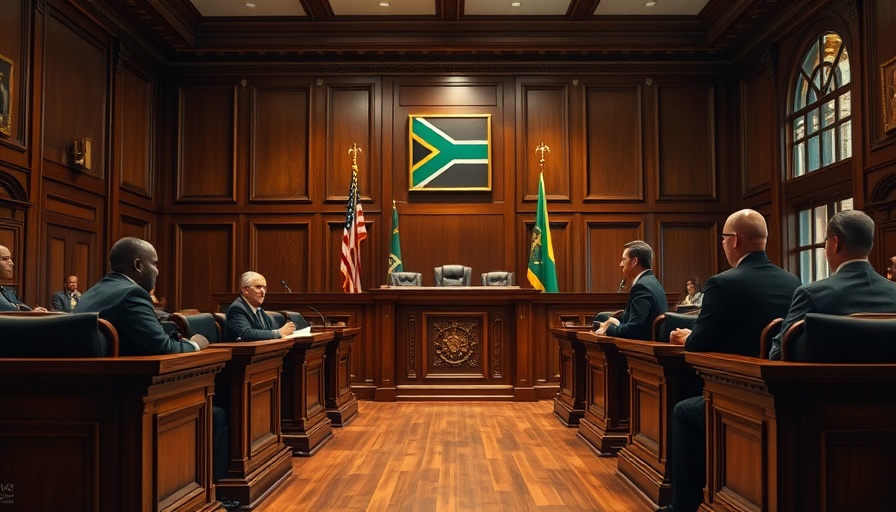
Courtroom discussing VAT increase in South Africa, judges and lawyers.

Legal Fallout from VAT Increase: Implications for South Africans

The recent decision by the Western Cape High Court to reserve judgment on the urgent application by the Democratic Alliance (DA) and Economic Freedom Fighters (EFF) regarding the impending Value-Added Tax (VAT) increase highlights a significant moment in South Africa's political and economic landscape. Set to take effect from May 1, this VAT hike, initiated during the 2025/2026 budget, has ignited heated debates around legality and fiscal responsibility.

Understanding the Dynamics of VAT in South Africa

Under the leadership of Finance Minister Enoch Godongwana, the contention arises from how Section 7(4) of the VAT Act is interpreted. He insists that the Act empowers him to implement temporary adjustments necessary for the economy, a point rejected by the opposition parties who argue that it centralizes excessive power in one individual and undermines democratic processes.

A Closer Look at the Political Stakes

As South Africa gears up for the 2024 general elections, the discourse surrounding the VAT increase illuminates broader issues of economic disparity and service delivery failures. The DA and EFF, prominent opposition parties, are using this court challenge as a platform to address public grievances, linking the VAT hike to a lack of progressive policies that adequately support the nation’s underprivileged communities.

Opposing Views: Key Arguments in the VAT Debate

Advocate Karrisha Pillay, representing Parliament, defends the legitimacy of the VAT adjustment, claiming all necessary procedures were observed leading to the vote on April 2. This perspective contrasts sharply with that of Keith Engel, CEO of the South African Institute of Tax Professionals, who advocates for a contextual understanding of the VAT regulations, suggesting the need for nuanced interpretations rather than blanket dismissals.

Future of Tax Policies and Public Sentiment

The implications of this court case extend beyond mere economics; they underscore a trend of increasing public scrutiny over government spending and taxation policies. As communities grapple with rising cost-of-living issues and stagnant social grants, voter turnout for the upcoming municipal elections in 2026 may hinge on the perceptions around fairness in taxation, particularly among young voters disillusioned by economic policies of the current coalition government.

Conclusion: The Path Ahead for South African Governance

As we await the court's decision, the VAT increase serves as a litmus test for the strength of South Africa's opposition and the robustness of government accountability mechanisms. It is a crucial time for citizens to reflect on their economic rights, the role of public sector reform, and the effectiveness of current anti-corruption measures. Public engagement and awareness will be pivotal to shaping the discourse around fiscal policies, especially with an upcoming election cycle that demands addressing the pervasive issues of income inequality and social justice.

Politics

23 Views

0 Comments

Write A Comment

*
*
Related Posts All Posts
12.19.2025

Defending Democracy: ANC Calls for Action Against AfriForum’s Racist Disinformation

Update Defending Democracy: ANC Calls for Action Against Racist Disinformation by AfriForum The African National Congress (ANC) has sharply criticized AfriForum’s recent actions, describing them as part of a broader "racist disinformation campaign" that threatens South Africa's democratic fabric. The allegations come in the wake of a controversial raid by the Department of Home Affairs on an "Afrikaner refugee" center, which was claimed by AfriForum to constitute harassment. This incident has amplified tensions within a nation still grappling with the legacies of apartheid and racial inequity. Contextualizing the ANC's Response In a recent statement, ANC spokesperson Mahlengi Bhengu claimed that AfriForum's actions are no longer fringe rhetoric, but rather a calculated political strategy aimed at destabilizing democracy and fracturing social cohesion. This view is supported by many political analysts who argue that such campaigns play into the hands of those desiring to maintain the status quo of racial privilege, often undermining efforts toward genuine reconciliation and justice. The Historical Narrative of AfriForum AfriForum, known for its strong advocacy of Afrikaner interests, has previously positioned itself against government-led land reforms and social initiatives aimed at rectifying historical injustices. The organization has focused its messaging on fear and misinformation, often manipulating narratives to frame the government’s policies as a direct threat to Afrikaner safety and rights. This tactic has garnered attention internationally, particularly within right-wing circles in the United States, including supporters of former President Donald Trump. Evaluating the Disinformation Campaign The disinformation promoted by AfriForum has evolved, particularly following inflammatory statements made by international figures like Trump, who echoed unverified claims of land confiscations in South Africa. Critics, including ANC leaders, argue that the fundamental objective of this misinformation is to block necessary reforms and perpetuate the socio-economic domination of a white minority. National Sovereignty at Stake The ANC has vehemently rejected any association with racism or hostility towards any community, insisting on the importance of unity as South Africa approaches crucial elections in 2024 and 2026. Mahlengi Bhengu emphasized that the government must act decisively against entities that spread racial hatred or interfere with the nation’s sovereignty. This stance reflects a broader push within the ANC to not only defend democracy but actively dismantle structures that facilitate racism and misinformation. The Role of Progressive Forces The ANC's call to action extends to all South Africans, urging them to participate in the protection of democratic values and oppose AfriForum's divisive tactics. This includes engaging civil society organizations, grassroots movements, and advocates for social justice, who play a crucial role in mobilizing citizens against discrimination and promoting national unity. Looking Ahead: The 2024 Landscape As the elections approach, the political landscape is likely to become increasingly polarized. The ANC’s resolve to counter such disinformation campaigns will be critical in maintaining voter trust and turnout, particularly among young voters who have expressed concerns regarding racial divisions and socio-economic inequality. The outcome of these elections could pivotally shape the nation's response to both domestic and international pressures related to democratic governance and human rights. The ANC’s fight is not only for political power but also a defense of the moral and ethical principles that guided the struggle against apartheid. The party’s success in these endeavors will heavily depend on the unity and mobilization of all South Africans in confronting narratives that threaten to undermine their shared history of struggle and hope. With rising concerns surrounding issues like land reform, economic redistribution, and racial reconciliation, South Africa stands at a critical juncture. The call to action resonates as a clarion call for solidarity against division.

12.18.2025

KZN's Political Landscape: MKP's Ongoing Fight for Justice and Safety

Update Political Turmoil in KZN: The Struggle for Safety and RepresentationThe political landscape in KwaZulu-Natal (KZN) is increasingly fraught as the uMkhonto weSizwe Party (MKP) prepares for another vote of no confidence against Provincial Premier Thami Ntuli. The stakes are high, particularly with looming local government elections, prompting MKP to emphasize safety concerns for their members amidst a climate marked by political violence.Following a chaotic scene in the legislature where a prior motion against Ntuli failed, MKP’s Head of the Presidency, Makasela Mzobe, expressed frustrations regarding what they perceive as systematic exclusion from governance—despite having emerged as a prominent party in recent elections. Mzobe mentioned, "KZN political killing is not our imagination, it’s a reality"—indicating a grim context for political actors in the region.The Demand for Secret Ballots: A Call for SafetyThe MKP's insistence on a secret ballot stems from serious threats reportedly received by party members as highlighted by Chief Whip Bonginkosi Mngadi. During prior sessions, members reported anonymous threats, underscoring the intimidating atmosphere surrounding dissent in KZN politics. Mngadi's urgent call for a secret vote reflects the broader concerns of ensuring personal security among legislators and enhancing voter turnout amidst fears of repercussions.The Speaker of the legislature, Nontembeko Boyce, however, ruled against the secret ballot. Her position is grounded in a commitment to transparency and accountability, suggesting that public votes promote integrity within democratic processes. However, the tensions witnessed, including a scuffle that resulted in a party member collapsing, raise critical questions about the operational conduct of political operations in the province.Contextualizing the Political Landscape: Legacy and Power DynamicsTo understand this tension, one must consider the implications of KZN’s political legacy. The region has long been a battleground for competing factions, notably the African National Congress (ANC) and various opposition parties like the Democratic Alliance (DA) and Economic Freedom Fighters (EFF). The dynamic necessitates a delicate balance among parties vying for power while claiming representation for distinct constituencies.The ruling ANC, alongside other coalition partners, has often faced criticism for perceived inequities in service delivery and economic policy changes. Meanwhile, the MKP cites its significant vote share as a mandate for legitimate governance—a component that could redefine KZN's political order as the 2026 municipal elections approach.Upcoming Elections: The Importance of Safety and DemocracyThe political unrest highlighted through these events poses challenges not only for the participants but also for South Africa's democratic health ahead of the 2024 general and 2026 municipal elections. With calls for electoral reform and robust anti-corruption measures, the landscape surrounding political intimidation must be thoroughly addressed.As political realignments unfold, the necessity of maintaining a clean electoral process becomes paramount. Observers now question how much longer the assembly can operate without addressing the pervasive issues of political safety, public trust, and the actual representation of voter interests.Conclusion: Stepping Toward a Sustainable Political EnvironmentThe steadiness of KZN’s political climate remains uncertain as local leadership contests intensify. For MKP and other opposition parties, demonstrating a commitment to democratic ideals necessitates engagement in practical solutions that ensure the protection of political actors and foster an environment conducive to free expression and dissent.As KZN moves toward yet another critical electoral period, it is crucial for both voters and political participants to advocate for mechanisms that prioritize security and uphold the integrity of the voting process. The focus must be on implementing systematic changes that curb violence and facilitate fair representation, ensuring every individual's voice counts in shaping the province's future.

12.17.2025

The Madlanga Commission: Unveiling the Truth Behind South Africa's Corruption Epidemic

Update A New Chapter in South Africa's Political Landscape The Madlanga Commission, an inquiry aiming to uncover corruption and hold accountable those purportedly involved in the state's capture, has made headlines as the interim report is handed to President Cyril Ramaphosa. Significant details surrounding the commission's proceedings shed light on a narrative filled with both hope and peril, especially for witnesses willing to testify against influential figures. Witness Protection: A Matter of Life and Death The urgency of witness protection in South Africa's turbulent political climate became tragically apparent with the assassination of Marius "Vlam" van der Merwe, a key witness known as Witness D. His testimony implicated senior police officials in corruption and murder cover-ups, raising alarm bells about the dangers that whistleblowers face in a system seemingly under siege from criminal elements. Despite existing laws protecting whistleblowers, execution remains appallingly ineffective, as evidenced by mounting fatalities among those who choose to speak out. Corruption Uncovered: The Ripple Effects Van der Merwe's murder isn't an isolated incident but part of a broader narrative of intimidation aimed at suppressing testimony against well-connected individuals. As political analyst Professor Andre Duvenhage indicates, the climate of fear deters many from coming forward, compelling the government to reevaluate the mechanisms in place for safeguarding those illuminating the dark corners of corruption. The Underlying Struggle for Justice The witness in question echoed the pent-up frustrations of many families seeking justice for loved ones harmed by systemic decay. At the Madlanga Commission, as families, like that of Emmanuel Mbense—an alleged torture victim—demand answers, the interconnectedness of their fights against an indifferent system becomes increasingly palpable. With the commission's findings currently withheld from the public, citizens wonder about the extent of political machinations cloaking crucial information. Calls for Reform: Can Change Be Achieved? The urgency for action is evident as various political parties, including the ANC and DA, rally for stronger anti-corruption measures amidst the growing disillusionment with how law enforcement interacts with those in power. This inquiry presents an opportunity for reform not only in police operatives but also in lawmaking—creating a pathway to ensure that those responsible for upholding justice are held accountable, rather than becoming complicit in the crimes they were meant to prevent. Political Ramifications Ahead of Elections As South Africa prepares for the 2024 general elections, the outcomes of the Madlanga Commission are likely to ripple through an already tense political landscape. Issues such as electoral integrity, the role of opposition parties, and the reliability of the ruling party come to the forefront. With rising public sentiment around gender-based violence, economic inequality, and systemic corruption, the commission’s findings could redefine voter turnout and influence key issues for various parties. As the nation holds its breath on the findings of the Madlanga Commission, one thing remains clear; citizens demand a government of national unity that prioritizes reform, accountability, and transparency. The preservation of South Africa's democracy might very well hinge on the outcomes of these inquiries, along with the strength and resilience of its civil society, ensuring that voices for justice and equality are heard amidst an orchestra of corruption. Call to Action: Embrace Change, Support Accountability Engaging in discussions surrounding the Madlanga Commission can propel South African society closer to the justice it desperately seeks. It is crucial now more than ever that citizens advocate for the release of the findings and engage politically to support reformative measures actively. Together, we can foster a climate where those who speak the truth are not silenced, and accountability reigns king.

Terms of Service

Privacy Policy

Core Modal Title

Sorry, no results found

You Might Find These Articles Interesting

T
Please Check Your Email
We Will Be Following Up Shortly
*
*
*